Friends2Support
India’s largest voluntary blood donor platform—search, request, and register for blood donations

Finding compatible blood units during acute medical emergencies, surgical procedures, or thalassemia treatments is time-critical. In India, numerous humanitarian NGOs, government initiatives like e-RaktKosh (Ministry of Health & Family Welfare), and the Indian Red Cross Society (IRCS) maintain 24x7 online databases to link voluntary blood donors with patients in distress. Explore official donation portals, consult the human blood group compatibility guide below, and review donor eligibility standards before donating.
Blood compatibility is determined by the presence or absence of specific antigens (A and B) and the Rh protein factor (+ or -) on the surface of red blood cells. Transfusing incompatible blood can trigger an acute hemolytic transfusion reaction. Understanding which blood type can safely donate to or receive from another is vital for patients, voluntary donors, and emergency caregivers:
O- blood can be transfused to patients of ALL blood groups (O-, O+, A-, A+, B-, B+, AB-, AB+). Because O- red cells lack A, B, and Rh antigens, it is the primary emergency blood used in trauma centers when a patient's blood type is unknown.
AB+ individuals can safely receive red blood cells from ALL blood groups. Since their red blood cells already possess A, B, and Rh antigens, their immune system will not produce antibodies against any incoming red blood cell type.
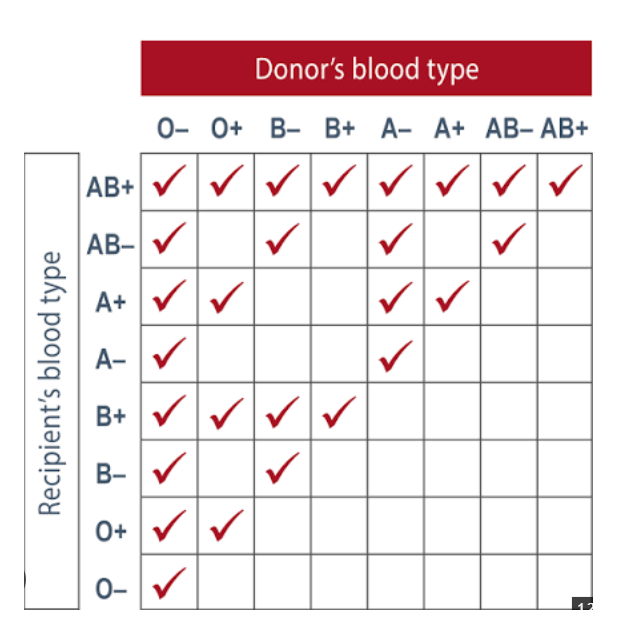 Chart: Donor's Blood Type (Top Columns) vs. Recipient's Blood Type (Left Rows). Red checkmarks (✓) confirm medically safe red blood cell transfusions.
Select your blood group below to see exactly who you can safely donate red blood cells to, and who you can safely receive blood from:
If you are O+, you can DONATE to:
If you are O+, you can RECEIVE from:
Browse leading blood request networks, voluntary donor directories, and government blood bank portals across India. Search by name (e.g., “Red Cross”, “e-RaktKosh”, “BloodConnect”) to find official contact links and emergency blood availability.
Under the National Blood Transfusion Council (NBTC) and Central Drugs Standard Control Organization (CDSCO) regulations, donors must fulfill these health requirements:
Donors must be aged between 18 and 65 years and weigh at least 45 kg (minimum 50 kg for apheresis / platelet donation).
Minimum hemoglobin must be 12.5 g/dL. Blood pressure must be within normal limits with no active fever, cold, or recent antibiotic intake.
Men can donate whole blood every 90 days (3 months), and women every 120 days (4 months). Platelet donors can donate every 14 days.
Blood donation in India is strictly voluntary and non-remunerated. Never pay advance cash or transfer funds to unknown individuals claiming to arrange blood online.
People with AB-positive (AB+) blood type are universal red blood cell recipients. Their red blood cells carry both A and B antigens as well as the Rh factor, meaning their immune system does not form antibodies against transfused A, B, AB, or O blood.
In India, voluntary blood donors must be between 18 and 65 years of age, weigh at least 45 kg, have a minimum hemoglobin level of 12.5 g/dL, have normal blood pressure (systolic 100-140 mmHg, diastolic 60-90 mmHg), and be free from active infections, jaundice, hepatitis, or recent antibiotic courses.
According to National Blood Transfusion Council (NBTC) guidelines, healthy adult men can donate whole blood every 90 days (3 months), while healthy adult women can donate every 120 days (4 months). Platelet donations (apheresis) can be done much more frequently—up to 24 times a year with at least a 7-day gap.
You can check real-time blood and component stock on the official Government of India portal e-RaktKosh (eraktkosh.mohfw.gov.in). You can search by state, district, and blood group to view live unit availability at licensed government and private blood banks.
Yes, blood donation is 100% safe. All collection needles, blood bags, and test tubes used by certified blood banks and authorized NGOs are sterile, single-use, and discarded immediately after collection. It is impossible to contract HIV, Hepatitis, or any blood-borne virus by donating blood.